Insight
The Best Offline Bank Statement Converters for Bookkeepers (2026)

Anson

You've got a stack of client statements to turn into spreadsheets, and the first tool you try wants you to upload them to its servers. So does the second one. The third suggests pasting the PDF into a chatbot.
For a lot of bookkeepers, that's the moment they stop and look at what's actually in the file. A bank statement has account numbers, transaction histories, payee names, running balances. It isn't yours, it's your client's. Handing it to a server you don't control to save a few minutes of typing doesn't always sit right.
Uploading a client's bank statement to ChatGPT raises the same problem in sharper form. The file, with everything in it, goes to a third party you don't control, and you can't take it back once it's there. For client work, some bookkeepers decide that isn't safe enough to be worth the saved minutes.
That's what sends people looking for the best offline bank statement converter: something that runs on your own machine and keeps the file on your computer. There's no single winner here. What's best depends on the formats you need, whether your statements are scanned or digital, and how often you do this. So treat this less as a ranking and more as a guide to what each option is actually good for.
What "offline" actually means
Not every tool that talks about privacy runs offline. Plenty of cloud converters say your files are deleted after 24 hours, which is a policy, not the same thing as the file never leaving your computer. If keeping client data local is the point, you want software that installs on your machine and does the conversion there, with no upload step at all.
Four things decide which offline tool fits your work:
Output formats. CSV and Excel cover most needs. If you import straight into QuickBooks or Quicken, you might want native QBO, OFX, or QIF instead.
Scanned versus digital. Most statements downloaded from online banking are digital PDFs, with the text already sitting in the file. Scanned or photographed statements need OCR, and not every offline tool reads them.
Platform. A lot of these are Windows-only. Mac and Linux support is patchier than you'd expect.
Cleanup. Some tools hand you clean columns. Others hand you a mess you fix by hand, which eats the time you were trying to save.
Keep those four in mind and the right pick usually gets obvious fast. The rest of this guide is really those four questions applied to each tool.
Dedicated offline bank statement converters
These are built for bank statements specifically, and it shows in the output. They can tell a running-balance row from a transaction, which the general PDF tools further down can't.
ProperConvert (ProperSoft)
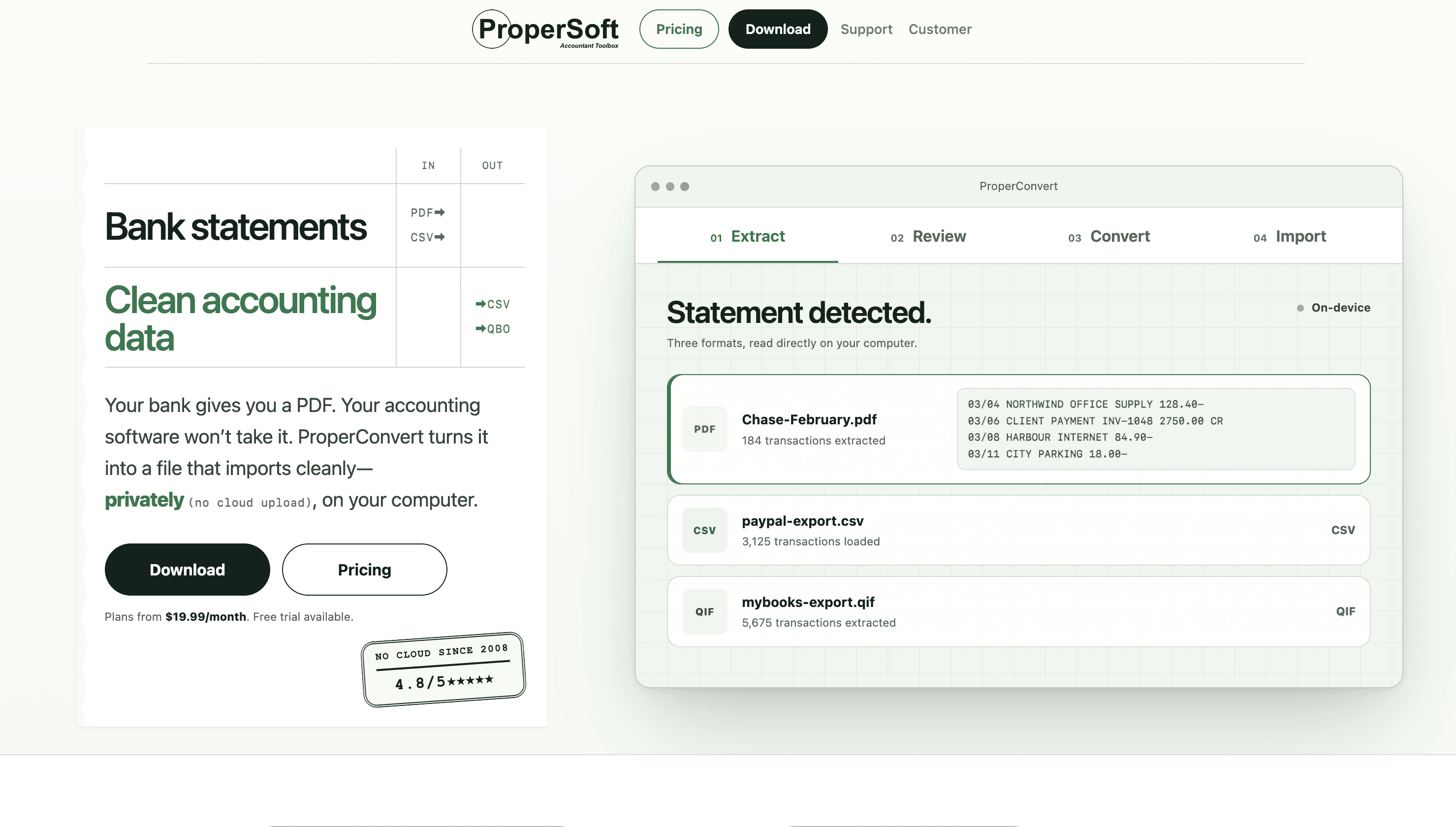
ProperConvert is the veteran. It runs entirely on your machine, Windows or Mac, no cloud version, and it reads a wide range of input formats (PDF, CSV, QBO, QFX, OFX, QIF, MT940) and writes most accounting formats back out. If your day ends in QuickBooks Desktop or Quicken, that native-format support is the reason to look here. ProperSoft also lists scanned and image PDF support, though digital is where it's strongest.
The catch is the interface, which hasn't had a real refresh in years and feels like it. Licensing is $199.99 one-time, $119.99 a year, or $19.99 a month for a single job. The free trial converts up to 10 transactions per file, enough to test it on your bank first.
This is the pick for a bookkeeper who lives in QuickBooks or Quicken and doesn't mind a dated screen. Less so if a clean, modern interface matters to you.
MoneyThumb
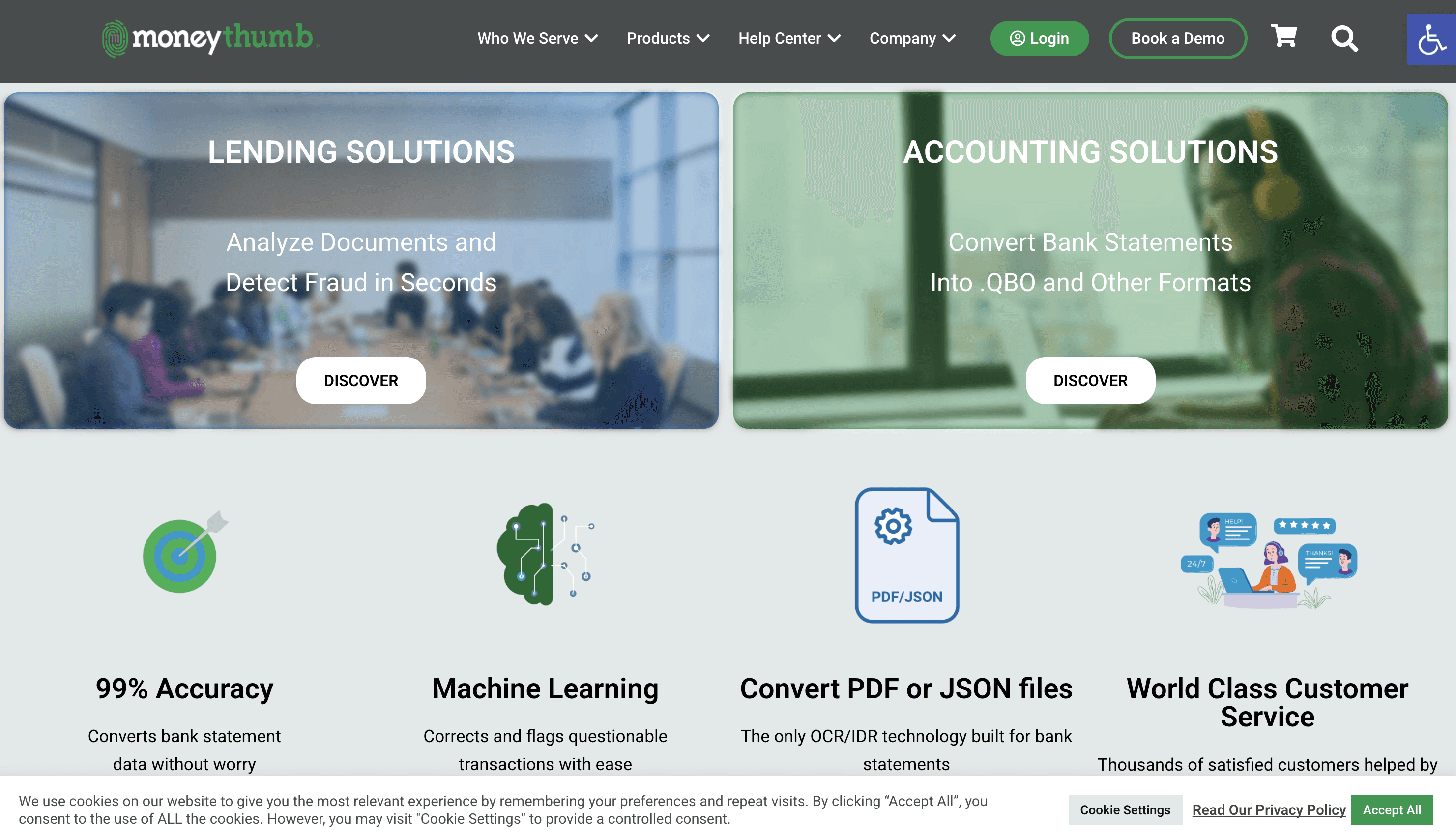
MoneyThumb has been at this for over a decade, and processing is local, so the statement stays on your computer. It's strong on single-format conversion, especially PDF to QBO for QuickBooks, and a PinPoint OCR add-on called PDF+ handles scanned statements (Windows only).
The part that trips people up is the product lineup. Rather than one tool, MoneyThumb sells a separate converter for each output format: pdf2csv, pdf2qbo, pdf2qfx, pdf2ofx, pdf2qif. If you need both CSV and QBO, that's two purchases, so a tool that looks like $59.95 becomes $119.90, with bundles running up past $599.
Buy it if you convert to a single output format regularly and want a tool built to do just that. It gets frustrating fast if you need several formats and find yourself paying per product.
Bank-Extract.com

Bank-Extract is the low-cost, focused option. It installs on Windows and turns digital PDF statements into CSV or Excel, reading the text layer directly with no AI in the loop, and a one-time license runs about $29. There's no OCR, though, so scanned statements are out. For the occasional clean digital PDF where you just want something local and simple, that's often enough. If your clients send scans, look elsewhere.
Docubrew
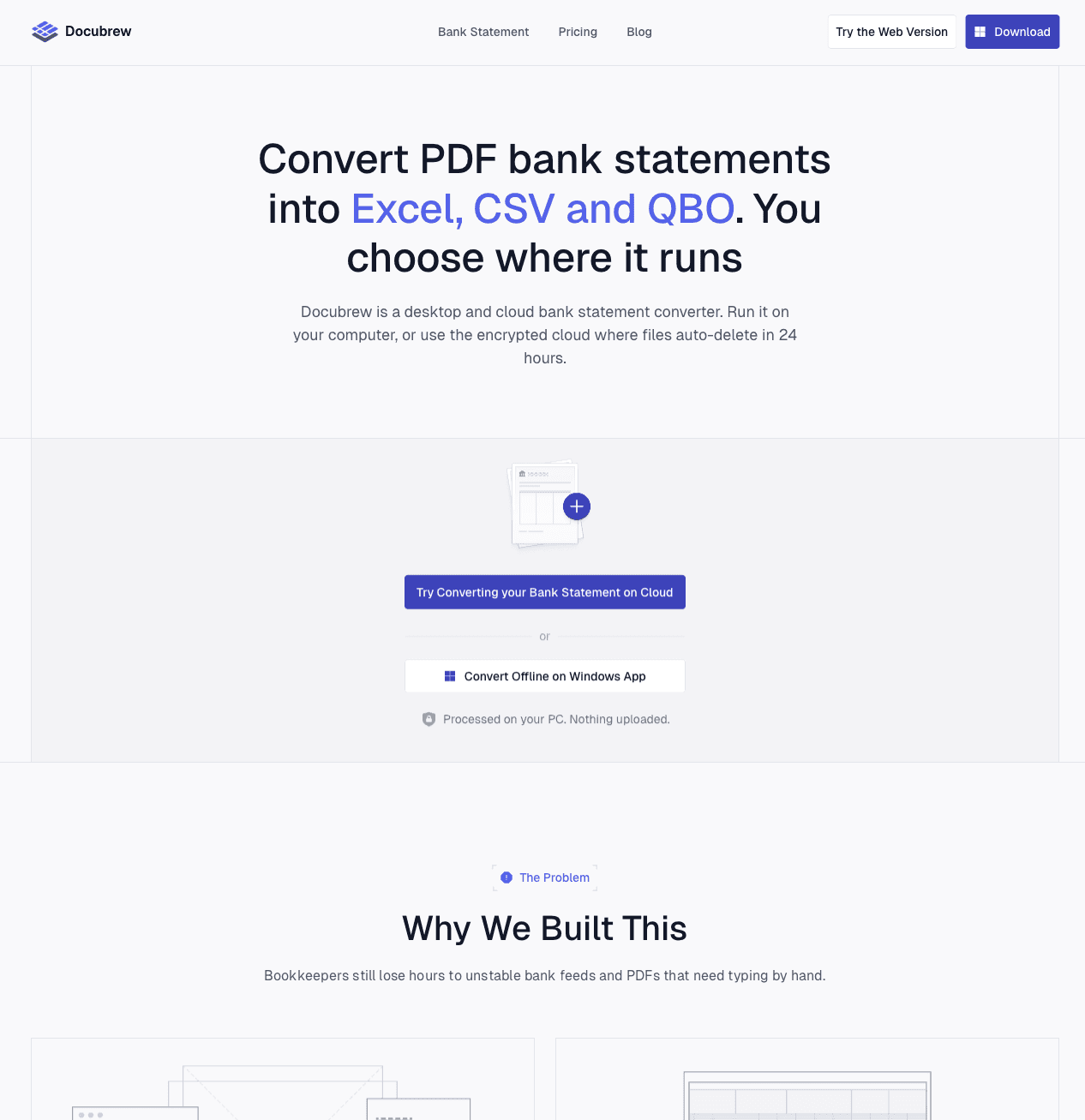
We make Docubrew, so treat this as us pointing at our own thing. It turns a PDF bank statement into a CSV or Excel file, with the date, description, and amount each in its own column, ready to open in a spreadsheet and import into QuickBooks or Xero. It runs on your own Windows machine, so the statement never leaves your computer, and it's rule-based, which just means the same statement always comes out the same way, with no model guessing at your numbers.
It's built for digital PDFs, the kind you download from online banking. It doesn't read scanned statements yet, and it's Windows-only for now. What it replaces is typing the rows in by hand, an afternoon instead of a week of evenings. Try it on a real statement and see if it saves you the evening.
The general-purpose PDF tools
Adobe Acrobat sits on nearly every bookkeeper's machine already. Able2Extract is less widespread but plays in the same lane, a general PDF tool rather than a bank-specific one. Neither was built for bank statements, but they're worth understanding because a general tool is usually what you try before buying a dedicated one.
Adobe Acrobat
If you have Acrobat, you've probably tried "Export to Excel" on a statement. On a clean, single-page table it can work. On an actual bank statement it tends to come apart: amounts land as text that won't sum, a debit loses its minus sign and reads like a deposit, and one long payee description spills onto the next row and knocks every figure below it out of line. The basic export runs locally, though Acrobat's newer AI features are cloud-based.
The problem isn't that Acrobat is bad software. It's a general PDF tool being asked to understand accounting, which it doesn't. You end up cleaning the export by hand, which is the work you were trying to skip.
It's fine for pulling a simple table out of a clean PDF. For a statement, you'll be finishing it by hand.
Able2Extract Professional
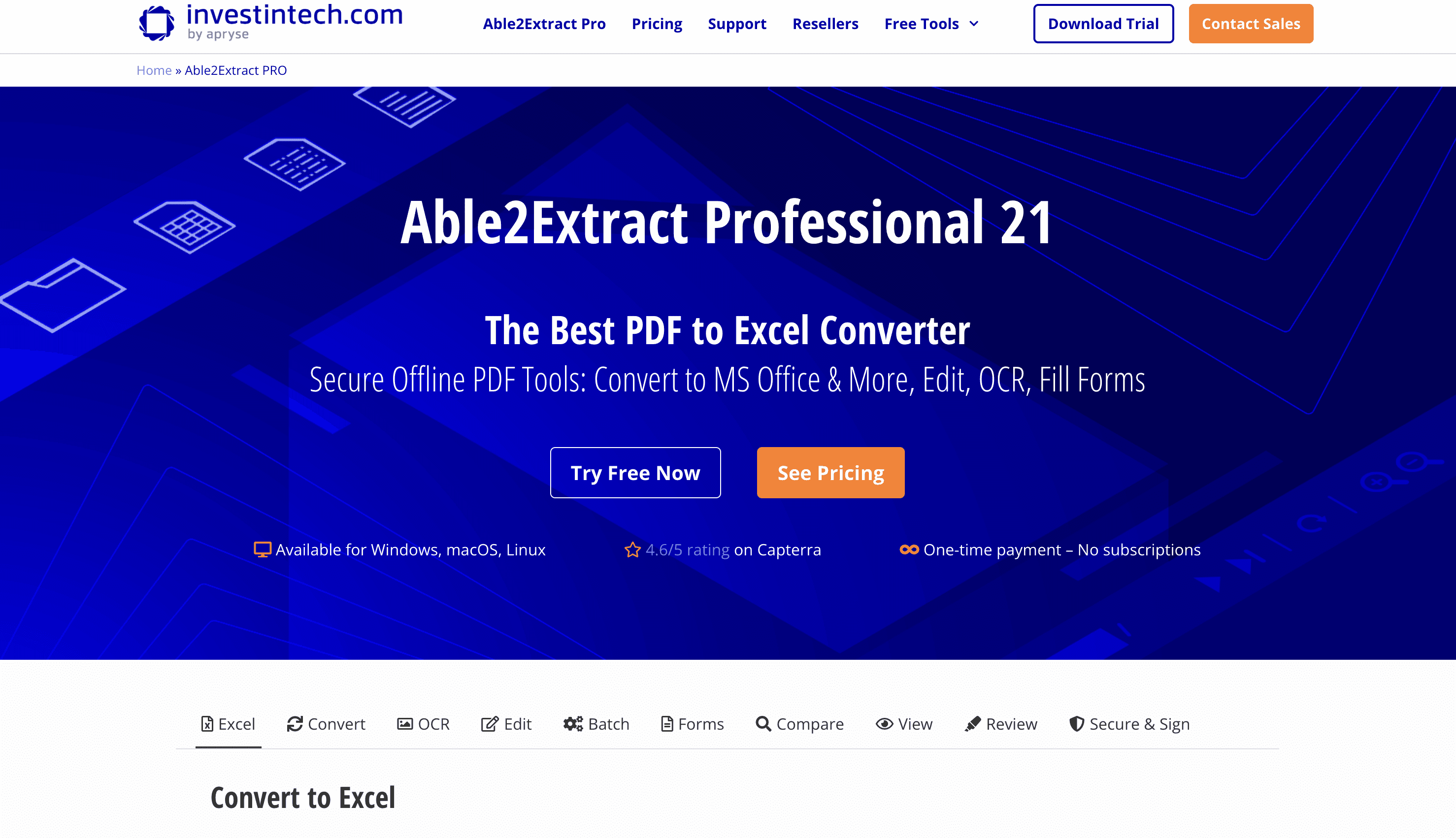
Able2Extract is the stronger generalist. It runs offline on Windows, Mac, and Linux, which makes it one of the few cross-platform options here, and it gives you real control over how tables get detected. Pricing is $49.95 for a 30-day license or $199.95 for a perpetual one.
The limit is the same as Acrobat's, just handled better. It extracts tables, but it doesn't know finance. It can't tell an opening balance from a transaction, or a transfer from a payment, so give the output a review pass before it reaches your accounting software. It earns its place mainly if you need cross-platform support, or you already own it and want more control over table detection than Acrobat gives.
The free and open-source route
If the budget is zero, there's a free route. Tabula is an open-source tool that pulls tables out of PDFs, and Python command-line tools like Monopoly and pdf_statement_reader do the same locally. They're free and stay on your machine, but they run from the command line and miss enough that you're checking every row. For a one-off, or if you're at home on the command line, that's a fair trade. For clean data every week the setup and fixing stack up against the typing you were trying to skip, and a paid converter usually earns its price back.
A note on the forensic tier
There's a whole category above all of this, built for fraud examiners, litigators, and law-enforcement investigators. It's worth knowing it exists, mostly so you can spot a tool that isn't built for you.
StatementReader sits at the accessible end, sold as per-page credit rather than a flat license, pennies a page bought in batches, with an offline mode for closed networks. ScanWriter is commonly cited around $5,495 up front, with annual maintenance on top, Windows-only, and it converts statements but leaves the analysis to you. At the top sit full investigation platforms like Altia's Financial Investigation Toolkit, sold by quote and priced for agencies rather than practices. Altia runs in the cloud as well as on a desktop and does its own OCR, so it's less a converter than an analysis suite.
Their approach, though, is worth learning from. These tools lean on deterministic extraction, pulling each figure from a known spot on the page so the same statement always reads the same way and every number traces back to where it came from. That's the same reason rule-based conversion matters for ordinary client work. You want the same input to always produce the same output, not a model's best guess. You don't need a $5,000 forensic suite for month-end bookkeeping. You just want to know the number is the number.
Which offline bank statement converter fits you
Skip the ranking and match the tool to your situation.
Importing into QuickBooks or Quicken and need native QBO or OFX files? Look at ProperConvert or MoneyThumb.
Clients sending scanned or photographed statements? You need OCR, so MoneyThumb's PDF+ add-on or one of the forensic tools, not the digital-only converters.
Occasional job on a clean digital PDF? A simple local converter, or even a free tool with a review pass, will do.
Most of your statements digital, and you mainly want CSV or Excel without the file leaving your machine? That's the narrower, faster lane the dedicated digital converters, our own Docubrew included, are built for.